Heating in a Place That Barely Freezes
A furnace that sits idle for eleven months gets one job all year: work on the single coldest night, without warning, on the first try.
August 25, 2026 · 3 min read
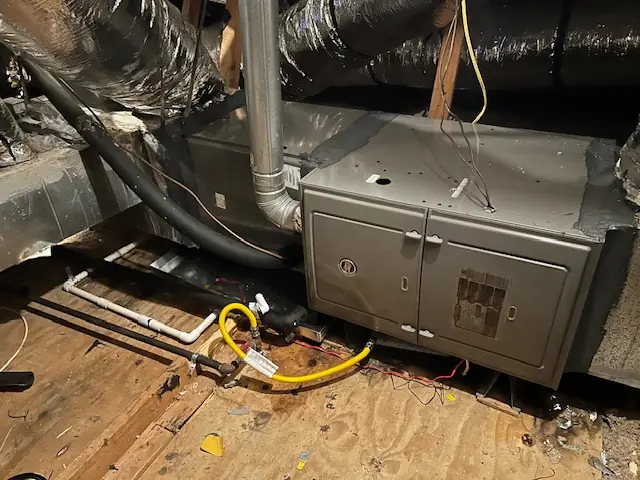
Nobody in Conroe thinks about their furnace in July. That's exactly the problem. A system built to run daily gets exercised and catches its own small issues along the way. A Texas furnace does the opposite: it sits in a hot attic for most of the year, then gets asked, with no warm-up period, to fire correctly the first cold night of the season.
A burning smell on the first cold morning is usually normal, briefly
When a furnace fires for the first time after months of sitting, dust that's settled on the heat exchanger and burners burns off, and it can smell like something's wrong even when nothing is. That smell should fade within a few minutes of the system running. If it doesn't fade, gets stronger, or smells more like plastic or gas than dust, that's no longer a first-light quirk. Turn the system off and call.
The flame sensor nobody thinks about until it fails
A flame sensor's whole job is confirming the burner actually lit, so the gas valve knows it's safe to stay open. Over months of sitting unused, a light film of carbon can build up on that sensor, and enough buildup makes it read as if there's no flame even when there is, so the system shuts itself down as a safety measure. This shows up as a furnace that tries to start, runs for a few seconds, and cuts off, sometimes repeating that cycle a few times before giving up. Cleaning that sensor is routine work during a seasonal check, and it's one of the more common reasons a furnace won't hold a flame on the year's first cold snap.
Igniters fail the same way, at the same time
Most furnaces in this area use an electric hot surface igniter instead of a standing pilot light. Like any component that sits unused for months, an igniter nearing the end of its life is far more likely to fail on the first attempt of the season than on the fiftieth. That's not a coincidence specific to bad luck; it's simply the first real test that component has faced since last winter.
What the fall tune-up is actually built to catch
Jack Gordon & Sons' fall heating check runs a combustion analysis, checks the ignition system, inspects the heat exchanger, and confirms the safety systems are working, all before the first real cold snap rather than after a failure. This is included in their VIP membership at a flat yearly rate, $225 for the whole home or $185 for seniors, military, and first responders, alongside a spring AC tune-up under the same plan. It's built around catching a weak sensor or a tired igniter on a mild afternoon in October instead of a freezing night in January.
Heat exchanger cracks are the one issue that isn't optional to address
A cracked heat exchanger can allow combustion byproducts, including carbon monoxide, to mix into the air your system is heating and circulating through the house. This is exactly what a combustion analysis and visual inspection during a tune-up are designed to catch early. If your home doesn't have working carbon monoxide detectors near sleeping areas, that's worth fixing independent of anything else in this article.
What's safe to check yourself before calling
- The thermostat is actually set to Heat, not Auto or Off
- The furnace's own power switch, often mounted like a wall light switch near the attic access or closet door
- The breaker feeding the furnace and blower hasn't tripped
- The air filter isn't so loaded it's choking airflow, the same check that matters in summer
That's the full list. Anything past it, especially the gas line, the flue, or a burner assembly, belongs to a licensed technician, not a homeowner with a flashlight.
When to stop troubleshooting and just call
If you smell gas, if a burning smell doesn't clear after a few minutes of runtime, or if a carbon monoxide detector goes off, don't keep testing the system yourself. Shut the furnace down, get everyone out of the house if gas is involved, and call from outside. Jack Gordon & Sons is open 24 hours a day, every day of the year, and a decision this one doesn't need to wait for morning.
Jack Gordon & Sons has serviced heating systems across Conroe and Montgomery County since 1971 and holds Texas License TACLB016624E. Call (281) 292-3398.
Jack Gordon & Sons Air Conditioning & Heating, (281) 292-3398
Call (281) 292-3398More articles
What Actually Fails on a Texas AC in August
The heat doesn't break your air conditioner. It finds the one part that was already tired and finishes the job.
How to Read a Replace-or-Repair Recommendation
A good replace-or-repair recommendation is math you can check, not a feeling you're supposed to trust.